Your team knows what to do.
So why aren't they doing it when it matters?
They don't need more training.
They need to execute when it matters.
When they hesitate, delay, or soften — you feel it immediately.
Pipeline becomes less predictable.
Forecasts become harder to trust.
You stay closer to things than you should.
And no matter how much training you give them, it keeps happening.
This changes that.
Not by adding pressure — by removing what's interrupting execution in the first place.
See measurable results in 7 days. No cost. No commitment.
The Problem
Your team knows what to do. So why isn't it happening?
When the moment to act shows up — they don't move.
Not because they don't know what to do.
Because something stops them in the moment.
The Cycle of Stagnation
Pipeline Stall
Management steps in to force activity, but you're treating the symptom, not the bottleneck.
This is what's happening in real time:
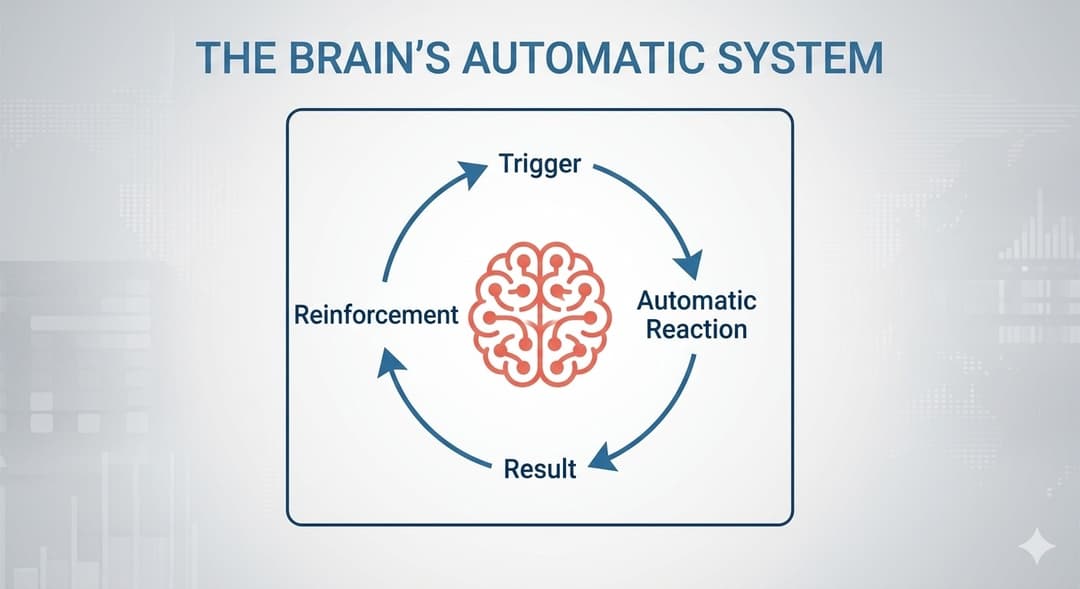
Pressure Moment → Prediction → Feeling → Action → Result → Pattern Strengthens
By the time you see the result, it's already decided.
This is happening inside your team every day. You just don't see it.
Same agent. Same prospect. Different reaction.
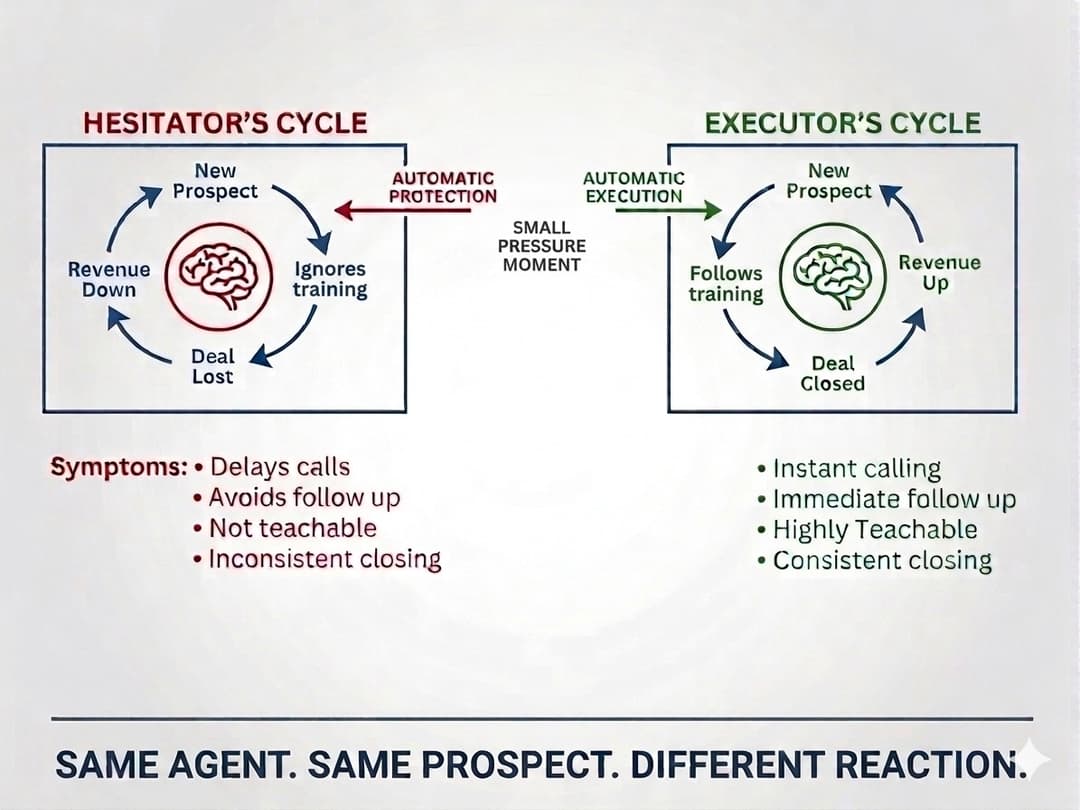
One reaction delays action and loses revenue.
The other moves immediately and captures it.
What looks like thinking is actually hesitation.
Reflection
Moves the deal forward.
“I'm reviewing the lead and I'll call by 2pm.”
Hesitation
Repeats without resolution.
“I'll think about it later.”
Hesitation is not thinking.
It is protection delaying the action that creates revenue.
Curious what this looks like for your team?
See How It Works →This is where most teams get stuck.
They try to fix behavior with more training.
But the problem is not knowing what to do.
It is what happens in the moment before the agent acts.
The Science
Why agents hesitate when they know what to do
A pressure moment happens — a lead, a follow-up, an objection, or a close.
Before the agent thinks, the brain predicts what will happen.
That prediction creates a feeling.
If action feels unsafe, hesitation takes over.
If action feels safe, execution happens.
Your agents are not choosing hesitation.
They are reacting to what their brain expects will happen.
Your agents aren't reacting to the prospect.
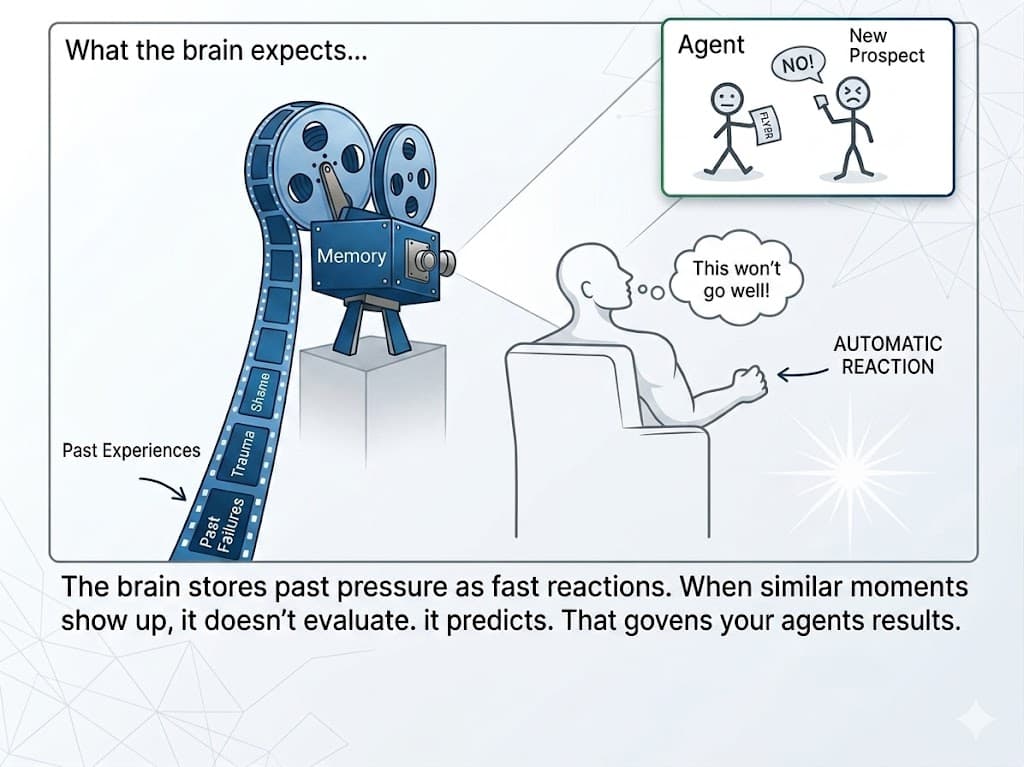
They're reacting to what they expect will happen.
That expectation comes from past pressure.
And it triggers the reaction automatically.
The Solution
The moment that determines your revenue
Automatic Hesitation System
Delays action · kills conversion
Automatic Execution System
Immediate action · compounds revenue
Same agent. Same lead. Different reaction. Different revenue.
You are not managing effort.
You are managing what happens before effort begins.
We change what the brain expects will happen in that moment.
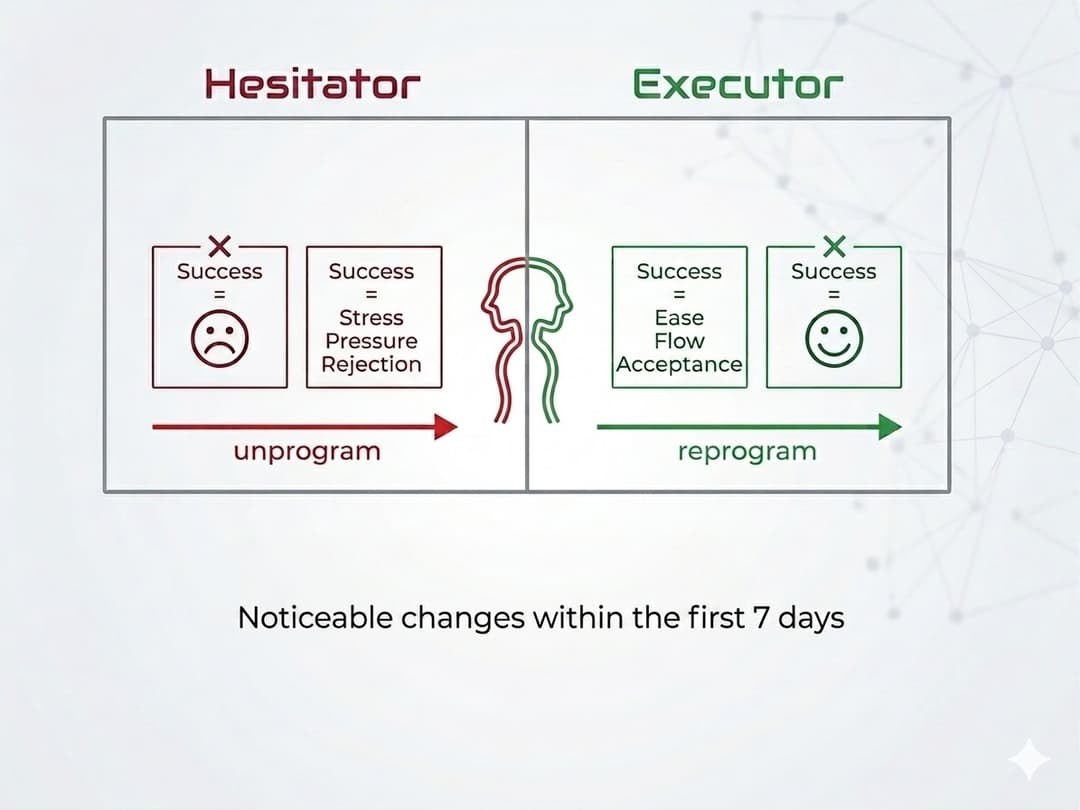
When action no longer feels unsafe, execution becomes faster, cleaner, and more natural.
Noticeable changes often appear within the first 7 days.
What this actually changes.
You stop chasing your team.
Agents proactively update you instead of avoiding contact.
You stop second-guessing forecasts.
Their projections actually happen.
You stop wondering who will execute.
Execution becomes consistent, not manager-dependent.
You stop carrying pressure that isn't yours.
The weight that should be theirs, stays with them.
Execution becomes more predictable.
And things finally feel easier to manage.
Real Results
Same pressure.
Two completely different outcomes.
One agent removed the internal friction. One agent tried to force through it.
John: Internal friction removed.
Financial Services · South Texas · Age 29
13 Days
To #1 Sales Agent in South Texas
$4,769
Commission in one night
John didn't struggle on calls. He couldn't even make them.
Every morning, he woke up knowing exactly what he needed to do. Build the pipeline. Close deals. But when decision points arrived, anxiety stopped him before he started. He would stare at the phone. Dread would build. The action would not happen.
“If I don't fix this, I'm done.”
We didn't give him more scripts. We identified the internal friction pattern stopping execution. Once removed, the change was immediate.
“I'm still sitting at #1 for value of business among new agents in South Texas.”
Two years later, John is married and making what used to take a year — in a single week.
And then there's what happens when you don't.
Theo: Internal friction forced.
Software Sales · Age 21
Theo had the mindset. He forced execution.
In his second week, he outperformed 70 people on the floor and became #1 in pacing to target. On the surface, Theo looked like proof that pressure worked.
“I set a record... outperforming every other person on the floor... got a message from the CEO.”
But the internal friction was never removed; he was simply overriding it every day. The internal pressure built. The system eventually broke.
Panic attacks. Burnout. Resignation.
Removing internal friction creates sustainable execution.
Forcing through it creates pressure that eventually breaks something.
Theo is still highly capable and ambitious, but he now actively avoids high-pressure environments because he knows what it cost his physical and mental health.
This is what's possible for your team.
See How We Do It →The Offer
One Agent. 90 Minutes. 7 Days. No Cost.
Here is exactly what happens — from the first session to the moment you decide.
The Session
We work with one agent — usually someone inconsistent or underperforming — in a structured 90-minute session at the exact point where execution breaks.
- →Identify the specific internal friction pattern
- →Work at the belief level, not behavior level
- →No scripts. No roleplay. No pressure.
The Shift
Over the next 7 days, you observe what changes. You're not told what to look for — you'll see it.
- →Do they follow up faster?
- →Do they hesitate less on objections?
- →Do they close with more confidence?
Your Decision
You decide if it worked. If nothing changes, you walk away. If it does, you'll know exactly what this looks like across your whole team.
- →No cost. No commitment.
- →No pitch at the end.
- →Just observable results.
No cost. No commitment. Walk away if nothing changes.
The Methodology
Who we are.
We don't replace your training. We unlock it.

Vadoll Webb
Identity Engineer
This system was born from a simple realization: Knowledge does not guarantee execution.
Vadoll Webb studied the nervous system to find a way to create predictable, measurable change — not just feel-good theory. Through 5+ years of research in a controlled 2,500+ participant environment, he proved that execution failure is rarely a choice; it is triggered by automatic protection patterns.
This does not replace sales training. It removes the internal interruption that stops capable agents from using the training they already have.
The goal is not to turn agents into robots. The goal is to remove the internal interruption so capable agents can finally use the scripts and training you already gave them.
— Founder, Frictionless Performance
Revenue Impact
How much revenue is hesitation costing you?
Most teams don't need more leads. They need to stop bleeding the opportunities they already have.
Contact Rate
Follow-Up Rate
Close Rate
Current Monthly Revenue
$10,000
Potential Monthly Revenue
$36,000
Estimated monthly leakage through hesitation
$26,000
That's $26,000 slipping through every month.
Schedule a Free Session →Start with one agent you're not fully confident in.
Not your best performer. A real baseline.
Day 1
90-min session
We work with one agent at the exact moment execution breaks.
Days 2–7
You observe
Watch for faster follow-ups, less hesitation, stronger closes.
Day 8
You decide
Results or not — no pressure, no pitch, no obligation.
Do they follow up faster?
Do they hesitate less?
Do they soften less?
Does execution become consistent?
No cost. No commitment.
If nothing changes, you walk away.
If it does, you'll know exactly what this can do across your team.